Halo Alpha

Rebranding Xodex and designing an AI-powered DeFi intelligence terminal that tripled the token price and brought 1,000+ new members to the community within weeks of its announcement.


Role

Lead Designer: Brand Identity, Product Design (sole designer)

Team

CEO, product manager, dev team

Engagement

Full-time at Xodex

Timeline

3 to 4 months

Surfaces

Brand identity, Telegram mini app, web app

project

Overview

Halo started as an extension to XO Wallet and became its own product: a standalone AI-powered terminal that filtered the noise of crypto social media and gave users clear, trustworthy signals to act on. It had two core surfaces, Yaps and Recon, each designed to solve a different side of the same problem: how do you know what to trust in a space full of scammers, paid promoters, and low-quality calls?

The product sat at the center of a larger strategic shift. Xodex was evolving from a pure Web3 company into a DeFi-meets-AI company, and Halo was the public face of that transition. Before I could design the product, I redesigned the brand.

The announcement alone, before the product fully launched, tripled the Xodex token price and brought over 1,000 new members into the community. Closed beta access was gated to users who staked the Xodex token, which created direct buying pressure as the community rushed to qualify.


The Problem

Crypto Twitter is simultaneously the most valuable source of market intelligence and the most polluted. Influencers shill tokens they dumped the day before. Meme coin callers rack up followers on one lucky pick and spend years capitalizing on that reputation. Legitimate signal gets buried under volume.

The people most affected are the users who can least afford to be: retail investors making decisions based on what they see in their feed, with no infrastructure to evaluate who is actually worth listening to.

Halo was built to be that infrastructure.


Understanding Who I Was Designing For


Persona 1

The Active Retail Trader

"I spend hours on crypto Twitter every day and I still can't tell who to trust."

Profile: 22-38 years old. Trades daily or weekly. Follows 200+ crypto accounts. Has been rugged or misled at least once. Understands DeFi basics but lacks the time or tools to vet every caller they follow.

Goals: Cut through the noise fast. Know which callers have a genuine track record. Make faster decisions with more confidence.

Design implication: The Yaps feed needed to feel like a curated version of Twitter, not a data dashboard. Information density had to be high but the trust signals had to be immediately readable, not buried in a score breakdown.


Persona 2

The Portfolio-Conscious Investor

"I want to understand what the market is doing before I make a move."

Profile: 28-45 years old. Holds a diversified DeFi portfolio. Less interested in hot calls, more interested in macro trends and fundamental signals. Has disposable capital but limited time to research.

Goals: Monitor portfolio health. Get relevant market news filtered to their holdings. Ask specific questions and get direct answers without wading through forums.

Design implication: The AI assistant needed to be positioned as a research tool, not a trade recommender. The disclaimer framework needed to be present but not anxious. Confident tone, clear limitations, no implied authority over the user's decisions.


Persona 3

The Community Member Entering DeFi

"I've been in the Xodex community for a while and I want to start trading more actively."

Profile: 20-32 years old. Already part of the Xodex Telegram community. Familiar with the ecosystem but not yet a confident trader. Motivated by Halo's closed beta to stake the token and get access.

Goals: Learn who the credible voices are. Use Halo as a starting point for research before committing funds. Feel like they have an advantage over people who are not using the product.

Design implication: Recon's influencer rankings needed to be readable without prior knowledge of who these people were. The ranking criteria, quality of calls over time, needed to be transparent so the system felt earned rather than arbitrary.


Phase 1: Rebranding Xodex as Halo

The rebrand was not cosmetic. Xodex was repositioning from a crypto-only company to a DeFi-plus-AI company, a category that did not have an established visual language yet. The brand needed to feel intelligent and precise without leaning on the tired tropes of either the crypto space or generic AI aesthetics.

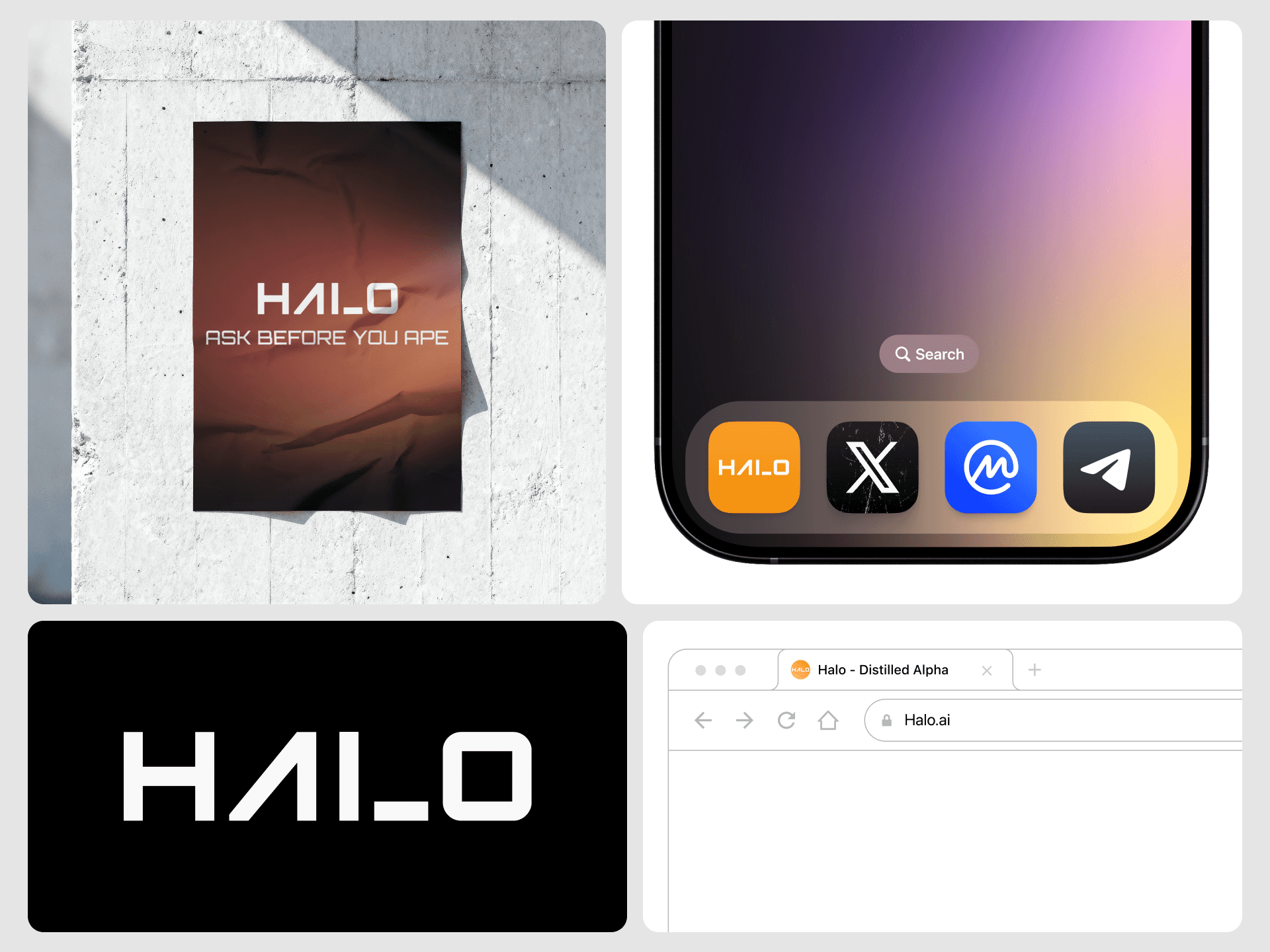
I developed the full Halo identity: logo, logotype, color system, typography, and icon guide. The name Halo suggested clarity, signal, and a kind of protective intelligence, which gave the visual direction a clear brief to work against. The design language moved away from Xodex's existing aesthetic and established Halo as a standalone product with its own presence.

Once the brand was approved, it carried through every surface: the Telegram mini app, the web app, and all marketing and community assets.

Phase 2: Product Design

The two-tab structure

Halo organized its core value into two tabs: Yaps and Recon.

Yaps was a distilled version of crypto Twitter. An AI agent read and evaluated content from Twitter continuously, filtered out spam, low-quality posts, and accounts with histories of fraudulent calls, and surfaced only what passed its quality threshold. Users got the signal without needing a Twitter account or spending hours in the feed.

Recon was the accountability layer. It ranked the top-performing callers and influencers by the actual quality of their calls over time, filterable by timeframe and performance category. If someone had a history of promoting tokens they quietly sold beforehand, that showed up in their ranking. The system made track records visible and comparable.

The legitimacy score

Each account in the Yaps feed carried a legitimacy score, generated by a combination of Halo's own AI agent and a third-party verification system. The score evaluated posting history, call quality, token promotion patterns, and community feedback signals.

The design challenge was making this score immediately useful without requiring the user to understand the methodology behind it. The solution was a tiered visual system: a clean numerical score accompanied by a clear label that translated the number into plain language. Accounts flagged as scammers received a distinct visual tag that made the warning impossible to miss. Users did not need to read the details to make the right call.

The AI assistant

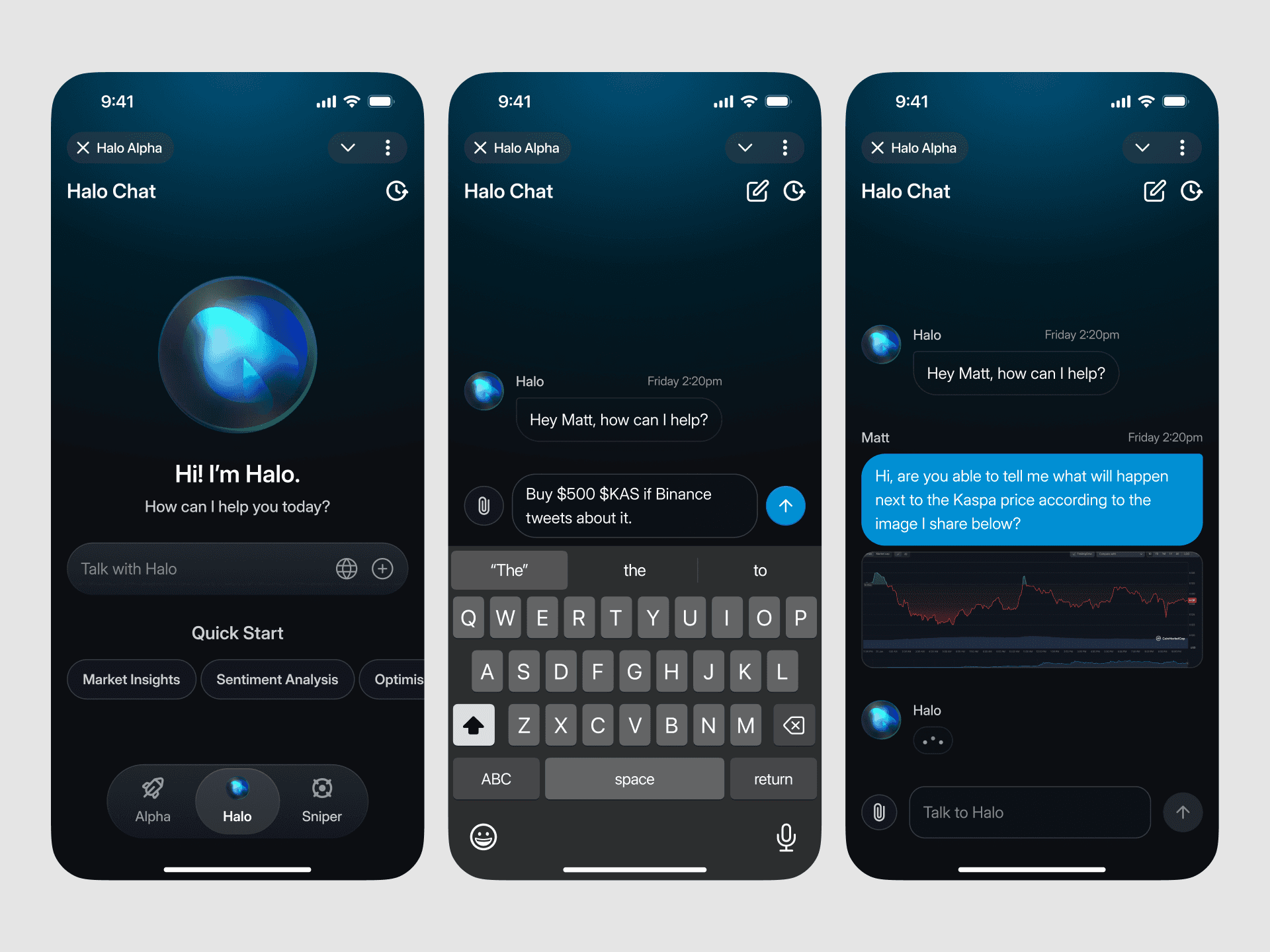
The AI assistant answered user questions about trades, market conditions, and specific assets. It did not recommend specific trades. Every response carried a clear disclaimer: the assistant can make mistakes, users should do their own research, this is a tool not an advisor.

The design challenge was framing this honestly without undermining the product's usefulness. A disclaimer that reads like a legal warning trains users to ignore it. The solution was to integrate the caveat naturally into the assistant's tone: confident, direct answers with a consistent acknowledgment that the user holds the final judgment. The assistant felt like a well-informed colleague, not a liability-covering chatbot.

The origin story: built as an extension first

Halo's first version was built as an extension to XO Wallet, not a standalone product. At that stage it carried the XO visual identity and lived inside the wallet's navigation. When the decision was made to separate it into its own product, I rebuilt the design from the brand level up, not just reskinning the existing screens but restructuring the information architecture for a product that now stood alone.

This two-stage evolution meant the final product was more considered than a greenfield build would have been. The extension phase revealed what users actually reached for, which informed how Yaps and Recon were prioritized in the standalone version.

Outcome

The announcement of Halo, before full launch, tripled the Xodex token price. Closed beta access was gated to users who staked the token, which created direct community buying activity as members competed for early access. This was not incidental: the token gate was a deliberate growth mechanism, and the design of the product had to be compelling enough that people were willing to commit capital to get in.

Open beta followed the closed beta with over 1,000 new Telegram community members joining during the launch window. Unsolicited feedback from users in the community included direct reports of improved trading performance since using Halo as a research layer.

Partnership and promotional campaigns extended reach beyond the existing Xodex community after launch.

Reflections

The AI agent was the most powerful and most fragile part of the product. It worked well but it worked as a black box. I would have pushed harder to introduce more human oversight into the legitimacy scoring system, not to replace the agent's judgment but to give users a way to flag disagreements and for the team to audit edge cases. A system people trust needs to be a system people can interrogate.

The second thing I would have done differently is pursue external funding earlier. The idea was genuinely strong and the market validation was immediate. A product that triples its associated token price on announcement and converts 17% of its addressable community in its first week has a real case to make to investors. The team did not pursue that path, and I think it limited how far the product could go.

Halo Alpha

Rebranding Xodex and designing an AI-powered DeFi intelligence terminal that tripled the token price and brought 1,000+ new members to the community within weeks of its announcement.


Role

Lead Designer: Brand Identity, Product Design (sole designer)

Team

CEO, product manager, dev team

Engagement

Full-time at Xodex

Timeline

3 to 4 months

Surfaces

Brand identity, Telegram mini app, web app

project

Overview

Halo started as an extension to XO Wallet and became its own product: a standalone AI-powered terminal that filtered the noise of crypto social media and gave users clear, trustworthy signals to act on. It had two core surfaces, Yaps and Recon, each designed to solve a different side of the same problem: how do you know what to trust in a space full of scammers, paid promoters, and low-quality calls?

The product sat at the center of a larger strategic shift. Xodex was evolving from a pure Web3 company into a DeFi-meets-AI company, and Halo was the public face of that transition. Before I could design the product, I redesigned the brand.

The announcement alone, before the product fully launched, tripled the Xodex token price and brought over 1,000 new members into the community. Closed beta access was gated to users who staked the Xodex token, which created direct buying pressure as the community rushed to qualify.


The Problem

Crypto Twitter is simultaneously the most valuable source of market intelligence and the most polluted. Influencers shill tokens they dumped the day before. Meme coin callers rack up followers on one lucky pick and spend years capitalizing on that reputation. Legitimate signal gets buried under volume.

The people most affected are the users who can least afford to be: retail investors making decisions based on what they see in their feed, with no infrastructure to evaluate who is actually worth listening to.

Halo was built to be that infrastructure.


Understanding Who I Was Designing For


Persona 1

The Active Retail Trader

"I spend hours on crypto Twitter every day and I still can't tell who to trust."

Profile: 22-38 years old. Trades daily or weekly. Follows 200+ crypto accounts. Has been rugged or misled at least once. Understands DeFi basics but lacks the time or tools to vet every caller they follow.

Goals: Cut through the noise fast. Know which callers have a genuine track record. Make faster decisions with more confidence.

Design implication: The Yaps feed needed to feel like a curated version of Twitter, not a data dashboard. Information density had to be high but the trust signals had to be immediately readable, not buried in a score breakdown.


Persona 2

The Portfolio-Conscious Investor

"I want to understand what the market is doing before I make a move."

Profile: 28-45 years old. Holds a diversified DeFi portfolio. Less interested in hot calls, more interested in macro trends and fundamental signals. Has disposable capital but limited time to research.

Goals: Monitor portfolio health. Get relevant market news filtered to their holdings. Ask specific questions and get direct answers without wading through forums.

Design implication: The AI assistant needed to be positioned as a research tool, not a trade recommender. The disclaimer framework needed to be present but not anxious. Confident tone, clear limitations, no implied authority over the user's decisions.


Persona 3

The Community Member Entering DeFi

"I've been in the Xodex community for a while and I want to start trading more actively."

Profile: 20-32 years old. Already part of the Xodex Telegram community. Familiar with the ecosystem but not yet a confident trader. Motivated by Halo's closed beta to stake the token and get access.

Goals: Learn who the credible voices are. Use Halo as a starting point for research before committing funds. Feel like they have an advantage over people who are not using the product.

Design implication: Recon's influencer rankings needed to be readable without prior knowledge of who these people were. The ranking criteria, quality of calls over time, needed to be transparent so the system felt earned rather than arbitrary.


Phase 1: Rebranding Xodex as Halo

The rebrand was not cosmetic. Xodex was repositioning from a crypto-only company to a DeFi-plus-AI company, a category that did not have an established visual language yet. The brand needed to feel intelligent and precise without leaning on the tired tropes of either the crypto space or generic AI aesthetics.

I developed the full Halo identity: logo, logotype, color system, typography, and icon guide. The name Halo suggested clarity, signal, and a kind of protective intelligence, which gave the visual direction a clear brief to work against. The design language moved away from Xodex's existing aesthetic and established Halo as a standalone product with its own presence.

Once the brand was approved, it carried through every surface: the Telegram mini app, the web app, and all marketing and community assets.

Phase 2: Product Design

The two-tab structure

Halo organized its core value into two tabs: Yaps and Recon.

Yaps was a distilled version of crypto Twitter. An AI agent read and evaluated content from Twitter continuously, filtered out spam, low-quality posts, and accounts with histories of fraudulent calls, and surfaced only what passed its quality threshold. Users got the signal without needing a Twitter account or spending hours in the feed.

Recon was the accountability layer. It ranked the top-performing callers and influencers by the actual quality of their calls over time, filterable by timeframe and performance category. If someone had a history of promoting tokens they quietly sold beforehand, that showed up in their ranking. The system made track records visible and comparable.

The legitimacy score

Each account in the Yaps feed carried a legitimacy score, generated by a combination of Halo's own AI agent and a third-party verification system. The score evaluated posting history, call quality, token promotion patterns, and community feedback signals.

The design challenge was making this score immediately useful without requiring the user to understand the methodology behind it. The solution was a tiered visual system: a clean numerical score accompanied by a clear label that translated the number into plain language. Accounts flagged as scammers received a distinct visual tag that made the warning impossible to miss. Users did not need to read the details to make the right call.

The AI assistant

The AI assistant answered user questions about trades, market conditions, and specific assets. It did not recommend specific trades. Every response carried a clear disclaimer: the assistant can make mistakes, users should do their own research, this is a tool not an advisor.

The design challenge was framing this honestly without undermining the product's usefulness. A disclaimer that reads like a legal warning trains users to ignore it. The solution was to integrate the caveat naturally into the assistant's tone: confident, direct answers with a consistent acknowledgment that the user holds the final judgment. The assistant felt like a well-informed colleague, not a liability-covering chatbot.

The origin story: built as an extension first

Halo's first version was built as an extension to XO Wallet, not a standalone product. At that stage it carried the XO visual identity and lived inside the wallet's navigation. When the decision was made to separate it into its own product, I rebuilt the design from the brand level up, not just reskinning the existing screens but restructuring the information architecture for a product that now stood alone.

This two-stage evolution meant the final product was more considered than a greenfield build would have been. The extension phase revealed what users actually reached for, which informed how Yaps and Recon were prioritized in the standalone version.

Outcome

The announcement of Halo, before full launch, tripled the Xodex token price. Closed beta access was gated to users who staked the token, which created direct community buying activity as members competed for early access. This was not incidental: the token gate was a deliberate growth mechanism, and the design of the product had to be compelling enough that people were willing to commit capital to get in.

Open beta followed the closed beta with over 1,000 new Telegram community members joining during the launch window. Unsolicited feedback from users in the community included direct reports of improved trading performance since using Halo as a research layer.

Partnership and promotional campaigns extended reach beyond the existing Xodex community after launch.

Reflections

The AI agent was the most powerful and most fragile part of the product. It worked well but it worked as a black box. I would have pushed harder to introduce more human oversight into the legitimacy scoring system, not to replace the agent's judgment but to give users a way to flag disagreements and for the team to audit edge cases. A system people trust needs to be a system people can interrogate.

The second thing I would have done differently is pursue external funding earlier. The idea was genuinely strong and the market validation was immediate. A product that triples its associated token price on announcement and converts 17% of its addressable community in its first week has a real case to make to investors. The team did not pursue that path, and I think it limited how far the product could go.

Halo Alpha

Rebranding Xodex and designing an AI-powered DeFi intelligence terminal that tripled the token price and brought 1,000+ new members to the community within weeks of its announcement.


Role

Lead Designer: Brand Identity, Product Design (sole designer)

Team

CEO, product manager, dev team

Engagement

Full-time at Xodex

Timeline

3 to 4 months

Surfaces

Brand identity, Telegram mini app, web app

project

Overview

Halo started as an extension to XO Wallet and became its own product: a standalone AI-powered terminal that filtered the noise of crypto social media and gave users clear, trustworthy signals to act on. It had two core surfaces, Yaps and Recon, each designed to solve a different side of the same problem: how do you know what to trust in a space full of scammers, paid promoters, and low-quality calls?

The product sat at the center of a larger strategic shift. Xodex was evolving from a pure Web3 company into a DeFi-meets-AI company, and Halo was the public face of that transition. Before I could design the product, I redesigned the brand.

The announcement alone, before the product fully launched, tripled the Xodex token price and brought over 1,000 new members into the community. Closed beta access was gated to users who staked the Xodex token, which created direct buying pressure as the community rushed to qualify.


The Problem

Crypto Twitter is simultaneously the most valuable source of market intelligence and the most polluted. Influencers shill tokens they dumped the day before. Meme coin callers rack up followers on one lucky pick and spend years capitalizing on that reputation. Legitimate signal gets buried under volume.

The people most affected are the users who can least afford to be: retail investors making decisions based on what they see in their feed, with no infrastructure to evaluate who is actually worth listening to.

Halo was built to be that infrastructure.


Understanding Who I Was Designing For


Persona 1

The Active Retail Trader

"I spend hours on crypto Twitter every day and I still can't tell who to trust."

Profile: 22-38 years old. Trades daily or weekly. Follows 200+ crypto accounts. Has been rugged or misled at least once. Understands DeFi basics but lacks the time or tools to vet every caller they follow.

Goals: Cut through the noise fast. Know which callers have a genuine track record. Make faster decisions with more confidence.

Design implication: The Yaps feed needed to feel like a curated version of Twitter, not a data dashboard. Information density had to be high but the trust signals had to be immediately readable, not buried in a score breakdown.


Persona 2

The Portfolio-Conscious Investor

"I want to understand what the market is doing before I make a move."

Profile: 28-45 years old. Holds a diversified DeFi portfolio. Less interested in hot calls, more interested in macro trends and fundamental signals. Has disposable capital but limited time to research.

Goals: Monitor portfolio health. Get relevant market news filtered to their holdings. Ask specific questions and get direct answers without wading through forums.

Design implication: The AI assistant needed to be positioned as a research tool, not a trade recommender. The disclaimer framework needed to be present but not anxious. Confident tone, clear limitations, no implied authority over the user's decisions.


Persona 3

The Community Member Entering DeFi

"I've been in the Xodex community for a while and I want to start trading more actively."

Profile: 20-32 years old. Already part of the Xodex Telegram community. Familiar with the ecosystem but not yet a confident trader. Motivated by Halo's closed beta to stake the token and get access.

Goals: Learn who the credible voices are. Use Halo as a starting point for research before committing funds. Feel like they have an advantage over people who are not using the product.

Design implication: Recon's influencer rankings needed to be readable without prior knowledge of who these people were. The ranking criteria, quality of calls over time, needed to be transparent so the system felt earned rather than arbitrary.


Phase 1: Rebranding Xodex as Halo

The rebrand was not cosmetic. Xodex was repositioning from a crypto-only company to a DeFi-plus-AI company, a category that did not have an established visual language yet. The brand needed to feel intelligent and precise without leaning on the tired tropes of either the crypto space or generic AI aesthetics.

I developed the full Halo identity: logo, logotype, color system, typography, and icon guide. The name Halo suggested clarity, signal, and a kind of protective intelligence, which gave the visual direction a clear brief to work against. The design language moved away from Xodex's existing aesthetic and established Halo as a standalone product with its own presence.

Once the brand was approved, it carried through every surface: the Telegram mini app, the web app, and all marketing and community assets.

Phase 2: Product Design

The two-tab structure

Halo organized its core value into two tabs: Yaps and Recon.

Yaps was a distilled version of crypto Twitter. An AI agent read and evaluated content from Twitter continuously, filtered out spam, low-quality posts, and accounts with histories of fraudulent calls, and surfaced only what passed its quality threshold. Users got the signal without needing a Twitter account or spending hours in the feed.

Recon was the accountability layer. It ranked the top-performing callers and influencers by the actual quality of their calls over time, filterable by timeframe and performance category. If someone had a history of promoting tokens they quietly sold beforehand, that showed up in their ranking. The system made track records visible and comparable.

The legitimacy score

Each account in the Yaps feed carried a legitimacy score, generated by a combination of Halo's own AI agent and a third-party verification system. The score evaluated posting history, call quality, token promotion patterns, and community feedback signals.

The design challenge was making this score immediately useful without requiring the user to understand the methodology behind it. The solution was a tiered visual system: a clean numerical score accompanied by a clear label that translated the number into plain language. Accounts flagged as scammers received a distinct visual tag that made the warning impossible to miss. Users did not need to read the details to make the right call.

The AI assistant

The AI assistant answered user questions about trades, market conditions, and specific assets. It did not recommend specific trades. Every response carried a clear disclaimer: the assistant can make mistakes, users should do their own research, this is a tool not an advisor.

The design challenge was framing this honestly without undermining the product's usefulness. A disclaimer that reads like a legal warning trains users to ignore it. The solution was to integrate the caveat naturally into the assistant's tone: confident, direct answers with a consistent acknowledgment that the user holds the final judgment. The assistant felt like a well-informed colleague, not a liability-covering chatbot.

The origin story: built as an extension first

Halo's first version was built as an extension to XO Wallet, not a standalone product. At that stage it carried the XO visual identity and lived inside the wallet's navigation. When the decision was made to separate it into its own product, I rebuilt the design from the brand level up, not just reskinning the existing screens but restructuring the information architecture for a product that now stood alone.

This two-stage evolution meant the final product was more considered than a greenfield build would have been. The extension phase revealed what users actually reached for, which informed how Yaps and Recon were prioritized in the standalone version.

Outcome

The announcement of Halo, before full launch, tripled the Xodex token price. Closed beta access was gated to users who staked the token, which created direct community buying activity as members competed for early access. This was not incidental: the token gate was a deliberate growth mechanism, and the design of the product had to be compelling enough that people were willing to commit capital to get in.

Open beta followed the closed beta with over 1,000 new Telegram community members joining during the launch window. Unsolicited feedback from users in the community included direct reports of improved trading performance since using Halo as a research layer.

Partnership and promotional campaigns extended reach beyond the existing Xodex community after launch.

Reflections

The AI agent was the most powerful and most fragile part of the product. It worked well but it worked as a black box. I would have pushed harder to introduce more human oversight into the legitimacy scoring system, not to replace the agent's judgment but to give users a way to flag disagreements and for the team to audit edge cases. A system people trust needs to be a system people can interrogate.

The second thing I would have done differently is pursue external funding earlier. The idea was genuinely strong and the market validation was immediate. A product that triples its associated token price on announcement and converts 17% of its addressable community in its first week has a real case to make to investors. The team did not pursue that path, and I think it limited how far the product could go.